Olympic Archery Format Explained
Olympic Archery Format Explained
Archery at the Olympic Games is a compact, spectator-friendly version of World Archery target competition designed to produce dramatic head‑to‑head matches while remaining tightly regimented for fairness and TV scheduling. This guide breaks down the events, equipment and distances, how the ranking and elimination rounds work, qualification pathways (including the confirmed changes for LA28), typical schedules, and what archery bettors should expect from sportsbooks around major events.
At a glance: the events and what’s changing
- Modern Olympic archery is conducted with recurve bows on a single distance: 70 metres (122 cm target face). ([worldarchery.sport](https://www.worldarchery.sport/news/200344/beginners-guide-archery-tokyo-2020-olympic-games?utm_source=openai))
- Since Tokyo 2020 the Olympic programme has included five medal events: men’s and women’s individual, men’s and women’s team, and mixed team (recurve). The mixed team made its Olympic debut at Tokyo 2020. ([worldarchery.sport](https://www.worldarchery.sport/sport/history/archery-olympic-games?utm_source=openai))
- The athlete quota has long been 128 total (64 men, 64 women); that remains the base for upcoming Games. For LA28 the IOC / World Archery have announced program changes that introduce a compound mixed‑team pathway (adding compound mixed team as a medal event) while keeping total quotas at 128 and adjusting team allocation. These LA28 details were published by World Archery on 5 February 2026. ([worldarchery.sport](https://www.worldarchery.sport/sport/history/archery-olympic-games?utm_source=openai))
What equipment and target specs are used at the Olympics
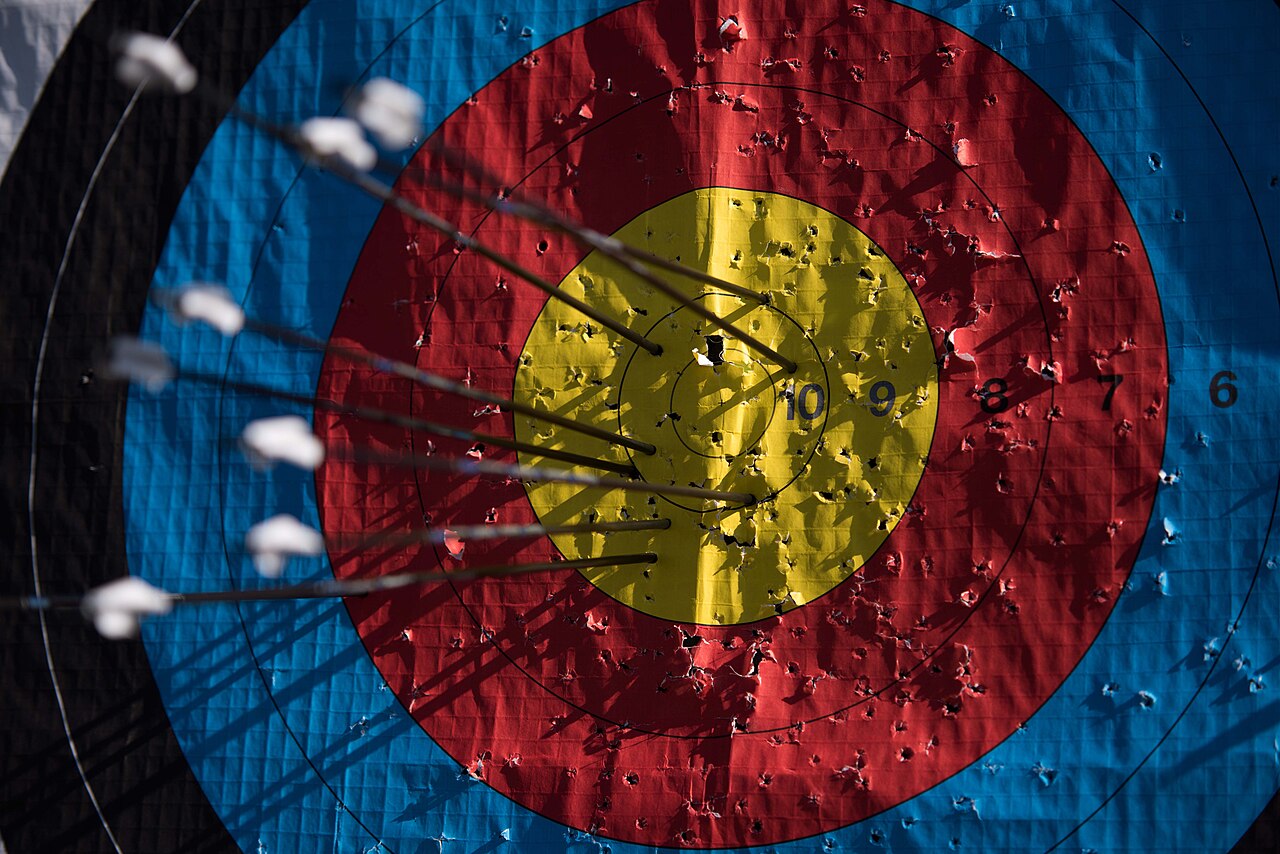
Olympic target archery uses only recurve bows for the traditional Olympic events (until LA28’s programme additions). The standard target face for Olympic recurve is 122 centimetres in diameter at 70 metres, with the 10‑ring measuring 12.2 cm across. Archers shoot outdoors under varying wind and light conditions, which increases the importance of form and mental control. ([documents.worldarchery.org](https://documents.worldarchery.org/Media/InformationSheets/011TheArcheryGlossary.pdf?utm_source=openai))
Event structure: ranking round then head‑to‑head
72‑arrow ranking round (the seed)
Every individual competitor shoots a 72‑arrow ranking round (often described as 12 ends of 6 arrows or 24 ends of 3—formats described in event handbooks vary). The sum of those 72 arrows sets:
- individual seedings (1–64) for the single‑elimination bracket
- team rankings (the three athletes’ combined scores seed the team bracket)
- mixed‑team rankings (the highest‑scoring man and woman from each NOC combine to form a mixed‑team seed).
The ranking round therefore matters not only for individual matchups but also for which nations qualify for team and mixed‑team elimination fields. ([worldarchery.sport](https://www.worldarchery.sport/news/200344/beginners-guide-archery-tokyo-2020-olympic-games?utm_source=openai))
The elimination brackets
For most recent Games the individual elimination bracket is 64 archers per gender (the Olympic quota allows 64 men and 64 women). Teams are seeded from the combined ranking round scores; at Paris 2024 the team fields were 12 per gender but World Archery has confirmed changes for LA28 that reduce recurve team quota slots, and add separate compound mixed‑team places. Always check the specific Games’ official explanatory materials for the final bracket sizes. ([worldarchery.sport](https://www.worldarchery.sport/sport/history/archery-olympic-games?utm_source=openai))
Match play scoring: the set system (how winners are decided)
The Olympic Round uses the World Archery set system rather than aggregated scoring for individual matches. The set system is simple to follow and creates tension because low‑scoring sets can be wiped out in the next.
Individual matches
- Each individual match consists of up to 5 sets.
- Each set: both archers shoot 3 arrows (maximum 30 points for a set).
- Win a set = 2 set points, draw a set = 1 point to each archer.
- First archer to reach 6 set points wins the match (e.g., 6‑0, 6‑4, 6‑2). If the match is tied 5‑5 after 5 sets, a one‑arrow shoot‑off decides the winner (closest to centre wins). ([worldarchery.sport](https://www.worldarchery.sport/news/200344/beginners-guide-archery-tokyo-2020-olympic-games?utm_source=openai))
Team matches (three‑archer teams)
- Team matches use the same set‑point idea but with four sets maximum.
- Each team set consists of 6 arrows total (two arrows per team member). The team with the highest set score wins 2 set points; a tie gives 1 point each.
- First team to 5 set points wins; if tied 4‑4 after four sets there is a shoot‑off in which each team member shoots one arrow (total three arrows per team). If the shoot‑off scores are tied, the closest arrow to centre decides the match. ([en.wikipedia.org](https://en.wikipedia.org/wiki/ArcheryOlympicRound?utm_source=openai))
Mixed‑team matches
- Mixed teams (one man + one woman) shoot up to four sets.
- Each set: 4 arrows per team (two per athlete). The first team to 5 set points wins; tied 4‑4 goes to a two‑arrow-per‑team shoot‑off (one arrow per archer) with the closest arrow to the centre breaking ties. ([worldarchery.sport](https://www.worldarchery.sport/news/200344/beginners-guide-archery-tokyo-2020-olympic-games?utm_source=openai))
Common tie‑break and procedural details
- Time limits: World Archery time limits per arrow/rotation are enforced in match play; penalties and score disputes are handled by target judges per the rulebook. ([extranet.worldarchery.sport](https://extranet.worldarchery.sport/documents/index.php/Rules/RuleBookversions/2026-01-27/EN-Book3–Differences–2026-01-27Version.pdf?utm_source=openai))
- Shoot‑offs are scored by closest‑to‑centre; if those distances tie, judges measure to millimetre precision (or use pre‑agreed tie‑breaking procedures). ([extranet.worldarchery.sport](https://extranet.worldarchery.sport/documents/index.php/Rules/RuleBookversions/2026-01-27/EN-Book3–Differences–2026-01-27Version.pdf?utm_source=openai))
- Ranking‑round ties are broken by number of 10s then Xs (inner‑10s), per World Archery/IOC event rules (see event technical handbook). ([library.olympics.com](https://library.olympics.com/Default/digitalCollection/DigitalCollectionAttachmentDownloadHandler.ashx?documentId=3157499&utm_source=openai))
How archers and NOCs qualify for the Games (overview)
Olympic quota places are allocated to National Olympic Committees (NOCs), not to individual athletes. Qualification pathways combine places won at the World Archery Championships, continental qualification events, mixed‑team qualification slots, and a final world qualification tournament. Historically there are 128 total archery slots (64 men, 64 women). Nations that qualify a team (three archers) automatically gain three individual quota spots and a team slot; other NOCs can qualify single individual places via continental and final qualification routes. ([worldarchery.sport](https://www.worldarchery.sport/news/201083/how-do-archers-qualify-paris-2024-olympic-games?utm_source=openai))
Important change for LA28: World Archery and the IOC released the LA28 qualification pathway in Feb 2026. The programme introduces compound archery through a compound mixed‑team medal event, reduces recurve team slots and reallocates quota pathways while keeping total quota at 128. The LA28 system raises some minimum qualification scores for recurve and sets minimum scores for compound mixed‑team eligibility. If you’re following qualification for 2028, consult the World Archery LA28 qualification document. ([worldarchery.sport](https://www.worldarchery.sport/news/202304/archerys-la28-olympic-games-qualification-pathway-released))
Typical Olympic competition schedule (how days are structured)
While exact timing is set by each Games’ organisers, the general pattern since London 2012 (and repeated in Tokyo 2020 and Paris 2024) has been:
- Day 1–2: Ranking round (all archers complete the 72‑arrow seed round).
- Middle days: Early elimination rounds (individual first and second rounds), which are staggered so some archers shoot in morning and others in afternoon blocks.
- Team competition days: team eliminations and medal matches are scheduled on specific days after or concurrent with early individual rounds; the mixed team medal often occurs early in the schedule. ([worldarchery.sport](https://www.worldarchery.sport/news/200343/archery-schedule-tokyo-2020-olympic-games-explained?utm_source=openai))
- Finals days: individual quarterfinals, semifinals and medal matches are concentrated in final days to suit broadcasting and stadium attendance. ([worldarchery.sport](https://www.worldarchery.sport/news/200343/archery-schedule-tokyo-2020-olympic-games-explained?utm_source=openai))
Betting on Olympic archery: markets, timing and sportsbook behaviour
Archery markets are relatively specialised and sportsbooks typically activate them around major international events — most notably the Olympic Games, World Archery Championships, and sometimes World Cup stages that attract wide interest. For example, DraftKings explicitly published Olympic‑betting guides listing archery among the sports it offered markets on during Paris 2024, and major bookmakers such as bet365 maintain dedicated archery rules pages describing match settlements and market types. That pattern — activation for major events and more limited availability otherwise — is the practical norm for archery betting. ([dknetwork.draftkings.com](https://dknetwork.draftkings.com/2024/07/26/how-to-bet-the-paris-2024-olympics-on-draftkings-sportsbook/?utm_source=openai))
Common markets archery bettors will see
- Match betting / head‑to‑head (individual match winner).
- Set betting (occasionally offered): predicting set scores or number of sets in a match.
- Outrights / futures (Olympic gold medallist, podium finishers) — usually offered in the run‑up to Olympics or Worlds.
- Team match betting and mixed‑team markets during team competition days.
- Prop markets (less common) such as “will match go to shoot‑off.”
Bookmakers’ archery rules typically specify settlement logic (e.g., that extra arrows count in settlement, and that futures are void/non‑runner if an athlete doesn’t start). Read the book’s official rules before wagering — bet365’s sports rules page for archery is a concrete example of the sort of policy you’ll find. ([help.bet365.com](https://help.bet365.com/s/en-us/sportsrules/archery?utm_source=openai))
From an archery bettor’s perspective: how to evaluate books
- Availability: confirm whether the sportsbook offers archery markets for the event you care about. Not all books list archery outside of multi‑sport championships and the Olympics. DraftKings and some large European books have historically activated Olympic archery markets; smaller or regional books may not. ([dknetwork.draftkings.com](https://dknetwork.draftkings.com/2024/07/26/how-to-bet-the-paris-2024-olympics-on-draftkings-sportsbook/?utm_source=openai))
- Market depth: check whether bookmakers provide simple match markets only or deeper options (set betting, shoot‑off props). Deeper markets may be thinly traded and the pricing can be inefficient — which can help informed bettors but raises liquidity and settlement risk. ([help.bet365.com](https://help.bet365.com/s/en-us/sportsrules/archery?utm_source=openai))
- Settlement terms: examine the sport‑specific rules for how shoot‑offs and ties are settled, and how postponed or partially completed matches are handled. These rules determine whether you get a void stake or a settled win/loss in unusual situations. ([help.bet365.com](https://help.bet365.com/s/en-us/sportsrules/archery?utm_source=openai))
- Geography and licensing: in some jurisdictions Olympic market availability will be limited by local law or licence decisions. If you’re outside major betting markets, your accessible books and market selection will differ. See your sportsbook’s Olympic betting guide or state‑by‑state Olympic market disclosures for details. ([dknetwork.draftkings.com](https://dknetwork.draftkings.com/2024/07/26/how-to-bet-the-paris-2024-olympics-on-draftkings-sportsbook/?utm_source=openai))
Responsible gambling note: Betting involves risk. Only wager what you can afford to lose and seek help if gambling becomes a problem (e.g., in the U.S. call 1‑800‑GAMBLER). This article is for information; it does not endorse any bookmaker.
How to analyse matches — what matters for bettors
Archery betting is less about form lines used in team sports and more about specific measurable indicators. Key variables to follow:
- Ranking round performance and wind tolerance: a high ranking‑round score suggests technical consistency; archers who regularly post higher 72‑arrow scores tend to be more reliable in head‑to‑head match play. ([worldarchery.sport](https://www.worldarchery.sport/news/200344/beginners-guide-archery-tokyo-2020-olympic-games?utm_source=openai))
- Recent head‑to‑head and match‑play record: some archers have excellent qualifying form but falter in match pressure. Look for competitors with recent wins in World Cups and World Championships elimination matches. ([thesportsexaminer.com](https://www.thesportsexaminer.com/page/19/?__wpdmviewcount=06acc8414b&id=4352&utm_source=openai))
- Venue and weather history: outdoor wind and lighting make a measurable difference. Past performance at the same venue or similar wind conditions is valuable data. Event practice sessions and weather forecasts should be checked on match day. ([worldarchery.sport](https://www.worldarchery.sport/news/200343/archery-schedule-tokyo-2020-olympic-games-explained?utm_source=openai))
- Team depth and mixed‑team pairing: for team and mixed bets consider how NOCs pair their archers (compatibility and experience shooting together matters). The mixed‑team event rewards nations with strong, balanced male and female archers even when a nation lacks enough depth to field a full recurve team. ([worldarchery.sport](https://www.worldarchery.sport/news/202329/archerys-mixed-team-gold-standard-modern-olympic-sport?utm_source=openai))
Because events are low‑scoring and variance is high (a single stray arrow can flip a set), bankroll management and small, value‑focused stakes fit archery better than heavy play on long parlay lines.
Editorial checklist (what to verify before you bet on a specific Olympic archery market)
- Is the market live at your sportsbook? (Some books only open archery markets during the Olympics/Worlds.) ([dknetwork.draftkings.com](https://dknetwork.draftkings.com/2024/07/26/how-to-bet-the-paris-2024-olympics-on-draftkings-sportsbook/?utm_source=openai))
- Has the athlete officially been entered by their NOC? (Quotas go to NOCs; rosters can be finalised late.) ([worldarchery.sport](https://www.worldarchery.sport/news/201083/how-do-archers-qualify-paris-2024-olympic-games?utm_source=openai))
- Check the event handbook for tie‑break and shoot‑off settlement rules (tie rules vary slightly by competition document). ([library.olympics.com](https://library.olympics.com/Default/digitalCollection/DigitalCollectionAttachmentDownloadHandler.ashx?documentId=3157499&utm_source=openai))
- Compare bookmaker markets and vigs; where liquidity is thin, price discrepancies can appear. Do not assume continuous markets — archery lines can be created, suspended or removed rapidly around scheduling changes. ([dknetwork.draftkings.com](https://dknetwork.draftkings.com/2024/07/26/how-to-bet-the-paris-2024-olympics-on-draftkings-sportsbook/?utm_source=openai))
Frequently asked questions (FAQ)
1. How far do Olympic archers shoot and how big is the target?
Olympic recurve archers shoot at 70 metres on a 122 cm diameter target face; the 10‑ring is 12.2 cm across. ([documents.worldarchery.org](https://documents.worldarchery.org/Media/InformationSheets/011TheArcheryGlossary.pdf?utm_source=openai))
2. How many arrows do they shoot in the ranking round?
Each archer shoots 72 arrows in the ranking round; that total determines individual, team and mixed‑team seedings. ([library.olympics.com](https://library.olympics.com/Default/digitalCollection/DigitalCollectionAttachmentDownloadHandler.ashx?documentId=3157499&utm_source=openai))
3. What is the set system?
Individual matches: best of 5 sets (3 arrows per set), with 2 set points for a set win and 1 for a draw; first to 6 points wins. Team matches: sets of 6 arrows (2 per team member), first to 5 set points wins (four sets maximum). Mixed teams: sets of 4 arrows (two per archer), first to 5 points wins. Shoot‑offs decide ties where required. ([worldarchery.sport](https://www.worldarchery.sport/news/200344/beginners-guide-archery-tokyo-2020-olympic-games?utm_source=openai))
4. Are sportsbooks offering archery markets year‑round?
Not usually. Most major sportsbooks activate archery markets around major international competitions (Olympics, World Archery Championships and certain World Cup stages). Market depth and availability vary by bookmaker and jurisdiction — always confirm availability before planning to bet. ([dknetwork.draftkings.com](https://dknetwork.draftkings.com/2024/07/26/how-to-bet-the-paris-2024-olympics-on-draftkings-sportsbook/?utm_source=openai))
5. What changed for LA28?
LA28’s published qualification pathway (World Archery, 5 Feb 2026) confirms the introduction of compound archery via a compound mixed‑team medal event and a reduction in recurve team slots (recurve team field reduced from twelve to eight per gender), while preserving a total athlete quota of 128 (64 men, 64 women). The pathway also raised minimum qualification scores for recurve and set standards for compound. Consult the World Archery LA28 documents for the full allocation tables. ([worldarchery.sport](https://www.worldarchery.sport/news/202304/archerys-la28-olympic-games-qualification-pathway-released))
Practical next steps for bettors and fans
- When a Games or World Championship approaches, bookmark World Archery’s competition pages and the official Olympic Games explanatory guide to confirm the event‑specific schedule, field sizes and tie‑break rules. ([library.olympics.com](https://library.olympics.com/Default/digitalCollection/DigitalCollectionAttachmentDownloadHandler.ashx?documentId=3157499&utm_source=openai))
- Check sportsbook help pages and sport rules (e.g., bet365’s archery rules) to understand settlement conditions and market availability. ([help.bet365.com](https://help.bet365.com/s/en-us/sportsrules/archery?utm_source=openai))
- Follow ranking‑round results live — a high‑seeding archer with proven match‑play experience is one of the best predictors of success, but upsets remain common so size your bets appropriately.