Olympic Archery Scoring Explained
Olympic Archery Scoring Explained
Clear, repeatable scoring is one reason archery translates well to both live audiences and betting markets. This guide explains exactly how Olympic (recurve) target archery is scored — from the 72‑arrow ranking round to head‑to‑head elimination matches and shoot‑offs — and what those rules mean for someone following or betting on high‑level tournaments. Where practical, this article separates verified rules (sources cited) from editorial notes aimed at archery bettors.
At a glance: the essentials
- Event discipline: Olympic archery uses recurve bows only; compound is not part of the Olympic programme. ([worldarchery.sport](https://www.worldarchery.sport/sport/equipment/compound?utm_source=openai))
- Distance and target: outdoor Olympic recurve is shot at 70 metres on a 122 cm diameter target face (ten concentric scoring rings, 1–10). ([frontiersin.org](https://www.frontiersin.org/journals/sports-and-active-living/articles/10.3389/fspor.2025.1650300/full?utm_source=openai))
- Ranking round: each archer shoots 72 arrows; the total (max 720) seeds the elimination bracket. ([dokumen.link](https://dokumen.link/en/Archeryatthe2016SummerOlympics%E2%80%93Women%27sindividual?utm_source=openai))
- Matchplay: elimination matches use the World Archery “set” system for recurve. Individual matches are up to five sets of three arrows; the first archer to 6 set points wins. ([worldarchery.sport](https://www.worldarchery.sport/news/99964/14-june-2010-set-system-new-era-world-archery-competition?utm_source=openai))
- Tie‑breaks: tied matches are decided by single‑arrow shoot‑offs (closest to centre wins). Ranking‑round ties use number of 10s then number of inner‑10s (X) as tie‑breakers. ([dokumen.link](https://dokumen.link/en/Archeryatthe2016SummerOlympics%E2%80%93Women%27sindividual?utm_source=openai))
1. The target and each‑arrow scoring
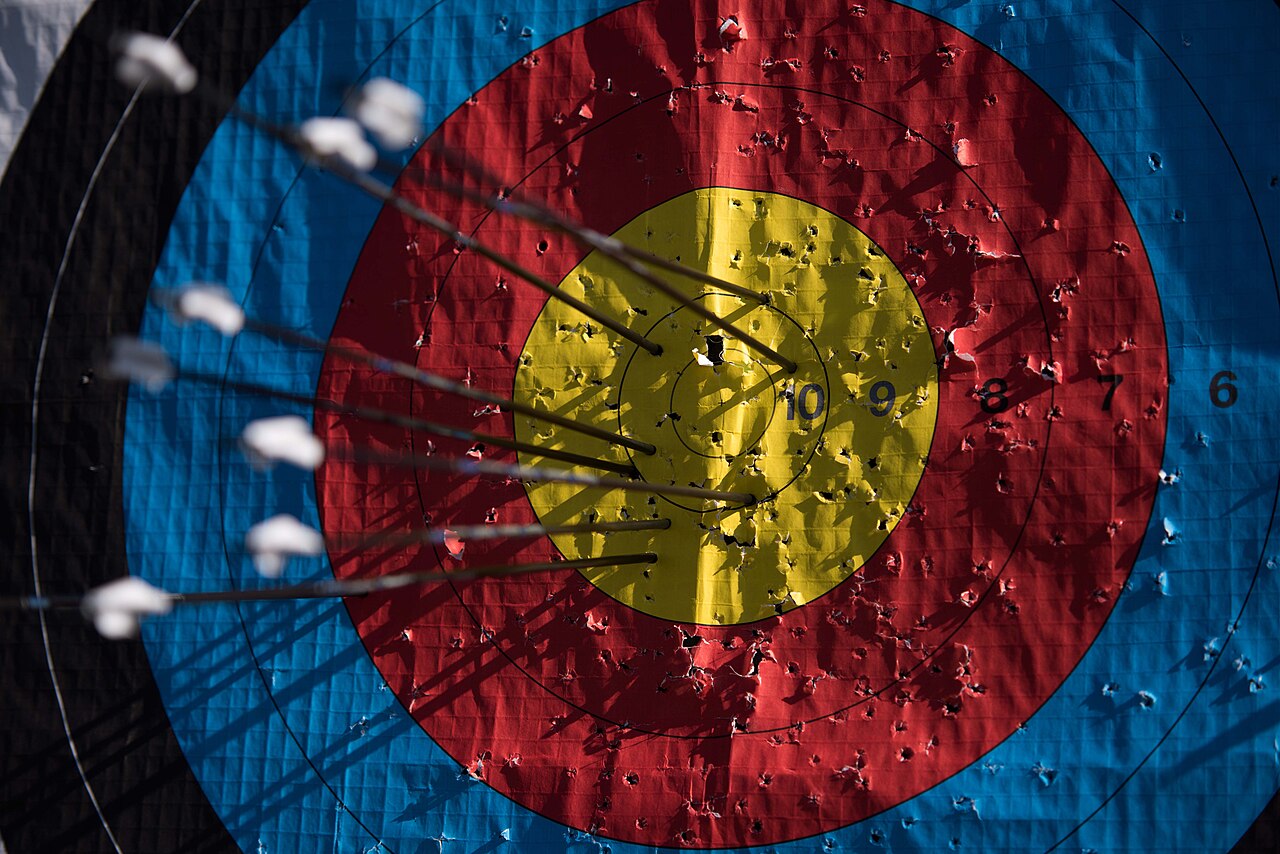
The standard Olympic target face is a 122 cm diameter circle divided into ten evenly spaced rings. Each ring gives a score from 1 (outermost white ring) to 10 (central gold). There is a smaller “inner‑10” (sometimes called the X‑ring) inside the 10; it counts as a 10 for scoring but is recorded separately for tie‑breaking and statistics. An arrow that misses the white ring scores 0. These dimensions and the 70 m shooting distance are set by World Archery and used in Olympic competition. ([opensourcesports.io](https://opensourcesports.io/rules/archery-world-archery/playing-area-3-3-range-dimensions-and-safety-zones?utm_source=openai))
Practical note for spectators and bettors: the visible gold/red/blue colour bands help judge arrow placement at a glance, but official scoring (and especially close measurements for Xs or shoot‑offs) is handled by judges and, at high levels, by video/measurement tools. Real‑time scoreboards and live stats feed into bookmakers’ settlement systems. ([help.bet365.com](https://help.bet365.com/s/en/sportsrules/archery?utm_source=openai))
2. The ranking round (seeding stage)
Before head‑to‑head matches begin every archer completes a 72‑arrow ranking round (commonly described as the 72‑arrow or “720” round). Archers shoot ends according to the event schedule (typically two halves of 36 arrows), and the sum of all 72 arrow values (maximum 720) determines the seedings for elimination brackets (e.g., 1 vs 64, 2 vs 63, etc.). The ranking round is also how teams are seeded for team and mixed‑team events because individual scores are summed to create team totals. ([dokumen.link](https://dokumen.link/en/Archeryatthe2016SummerOlympics%E2%80%93Women%27sindividual?utm_source=openai))
Tie‑break rules in the ranking round: if archers finish with the same 72‑arrow total, placement is decided first by who shot more 10s (including inner 10s), then by who has more inner‑10s (Xs). If still tied, competitions use the established tie procedure in the applicable rulebook (rarely reaching coin‑flip territory at elite levels). ([dokumen.link](https://dokumen.link/en/Archeryatthe2016SummerOlympics%E2%80%93Women%27sindividual?utm_source=openai))
3. Matchplay scoring: the set system
World Archery introduced the set system for Olympic‑round matches to reward consistency and keep matches competitive and spectator‑friendly. The set system works differently for individuals and for teams/mixed teams; the core idea is the same: win sets to earn set points, with a fixed number of points needed to win the match. ([worldarchery.sport](https://www.worldarchery.sport/news/99964/14-june-2010-set-system-new-era-world-archery-competition?utm_source=openai))
Individual matches (recurve)
- Each set: 3 arrows per archer.
- Scoring per set: the archer with the higher set total wins the set and receives 2 set points; a tied set gives 1 set point to each archer.
- Match victory: first archer to reach 6 set points (maximum five sets). If the score reaches 5–5 after five sets, the match goes to a single‑arrow shoot‑off. ([worldarchery.sport](https://www.worldarchery.sport/news/99964/14-june-2010-set-system-new-era-world-archery-competition?utm_source=openai))
Team and mixed‑team matches
Team composition and shooting time differ from individual matches, but the set‑based idea is used so that each set’s result gives set points to teams rather than cumulative totals. Team matches are shot with each team firing a set number of arrows per set (commonly 6 arrows per team set in three‑archer teams; each archer shoots two arrows per set). Mixed teams (one man, one woman) typically shoot 4 arrows per set (two per archer). Sets award set points (2 for a set win, 1 each for a tie), and the first team to the required set‑point threshold wins — formats vary slightly by event but follow World Archery competition rules. ([opensourcesports.io](https://opensourcesports.io/rules/archery-world-archery?utm_source=openai))
Practical note: timing and shooting order matter in team formats. At medal matches teams often shoot in alternate sequences with short per‑arrow or per‑end time limits; this increases the pressure and creates moments when bookmakers update in‑play prices. ([worldarchery.sport](https://www.worldarchery.sport/news/99964/14-june-2010-set-system-new-era-world-archery-competition?utm_source=openai))
4. Shoot‑offs and tie resolution
When a match is tied after the scheduled sets, a single‑arrow shoot‑off decides the winner. Each archer shoots one arrow; the higher scoring arrow wins. If both shoot the same score (for example, both 10s) the arrow closest to the centre wins. If a perfect tie on distance occurs, additional single arrows are shot until a winner is found. For ranking‑round ties that affect seeding, the established tie‑break chain (10s, then Xs, then shoot‑off if required) is used. ([dokumen.link](https://dokumen.link/en/Archeryatthe2016SummerOlympics%E2%80%93Women%27sindividual?utm_source=openai))
From a betting angle: shoot‑offs are the most volatile micro‑events in archery markets. Some bookmakers settle “match winner” markets immediately after a shoot‑off result is official; others will specify that “extra arrows” count for settlement (check the operator’s rules). The presence of a shoot‑off can change in‑play odds dramatically in a few seconds. ([help.bet365.com](https://help.bet365.com/s/en/sportsrules/archery?utm_source=openai))
5. Timing, ends and practical competition flow
Time limits for shots are strict at elite events. Typical timings you will see at Olympics and World Championship medal rounds are 20 seconds per arrow in alternate shooting for medal matches; earlier elimination sets sometimes allow longer time windows or simultaneous shooting with per‑end limits. These timing rules are part of World Archery’s match protocol and vary by round and competition stage. ([worldarchery.sport](https://www.worldarchery.sport/news/99964/14-june-2010-set-system-new-era-world-archery-competition?utm_source=openai))
Because matches are short (individual: at most 15 arrows per archer in a five‑set match), a single errant arrow can swing set points and match odds quickly. That is why match‑level betting includes set‑winner and end‑winner markets in addition to simple match‑winner markets.
6. What bettors must know: markets, settlement and data
Archery betting is niche compared with football or tennis, so market availability and depth are highly event‑dependent. Bookmakers typically offer the broadest archery menus — match winner, set winner, totals/over‑under sets, and futures (medal winner / podium) — for major competitions: the Olympic Games, the World Archery Championships, Hyundai Archery World Cup stages and sometimes continental championships. Outside these events coverage can be sporadic. ([sbo.net](https://www.sbo.net/archery/?utm_source=openai))
Bookmakers settle archery bets using official results feeds and their own sports‑rule pages. For example, established global operator bet365 publishes an archery rules page explaining which markets are voided if matches do not complete, how outright/podium bets are settled, and that extra (shoot‑off) arrows count for settlement where applicable. Always check the operator’s sports rules for archery before placing bets. ([help.bet365.com](https://help.bet365.com/s/en/sportsrules/archery?utm_source=openai))
Evaluating a bookmaker for archery betting — an example: bet365
Why mention bet365? It is one of the largest global sportsbooks and explicitly documents archery settlement rules and the use of official score providers for settling wagers—features that matter to archery bettors. The two most important practical checks for an archery bettor are: (1) does the sportsbook publish clear archery settlement rules, and (2) does it offer in‑play markets with an up‑to‑date live scoring feed during major events? bet365 satisfies both items in its help pages. ([help.bet365.com](https://help.bet365.com/s/en/sportsrules/archery?utm_source=openai))
Editorial assessment (criteria explained): for an archery bettor we value (A) reliable real‑time scoring (so in‑play prices reflect set‑by‑set progress), (B) explicit settlement policy for shoot‑offs and incomplete matches, and (C) some cash‑out functionality because matches swing fast. bet365’s published rules and historic coverage during Olympics/World Cups make it a practical choice when archery markets are available — but availability is not continuous and tends to cluster around major events. Always verify current market availability on the operator before attempting to place live or exchange bets.