Indoor World Series Format Explained
Indoor World Series Format Explained
The Indoor Archery World Series (IWS) is World Archery’s winter circuit of 18‑metre indoor tournaments that combines mass‑participation events with elite competition. This guide explains how the series is structured, the on‑range format (qualification and matchplay), how rankings and points work, what betting markets you can expect, and how sportsbooks typically treat archery markets from an archery‑bettor perspective. Wherever possible the facts below are cited from World Archery or bookmaker documentation; editorial comments are clearly labelled.
Quick overview — what the Indoor World Series is
- The IWS is an international 18‑metre indoor circuit run by World Archery; stages are open to any archer registered with a national federation, letting amateurs and elites compete at the same venues. (worldarchery.sport)
- Stages are graded by points (commonly 250, 500 and 1000 level events), with an elite ranking and an open ranking produced for the season. In the 2025–26 season World Archery expanded the tour and adjusted the end‑of‑season structure so elite champions are determined by rankings rather than a standalone Finals. (worldarchery.sport)
- Typical stages include traditional indoor events (Nîmes, The Vegas Shoot, Taipei, Nîmes etc.). The circuit’s technical rules follow the World Archery competition rulebook and IWS rule supplements. (worldarchery.sport)
Competition format — on the range
Two phases: qualification (60 arrows) and elimination
Every standard IWS stage has two distinct phases: a 60‑arrow qualification round at 18 metres and a head‑to‑head elimination phase seeded from that qualification score. The 60‑arrow score (first phase) both seeds elimination draws and, for the open ranking, forms the score that is used to rank archers across the series. Typically a cut is applied so only the top 32 or top 64 proceed to matchplay depending on entry numbers and the organiser’s setup. (worldarchery.sport)
Targets and scoring
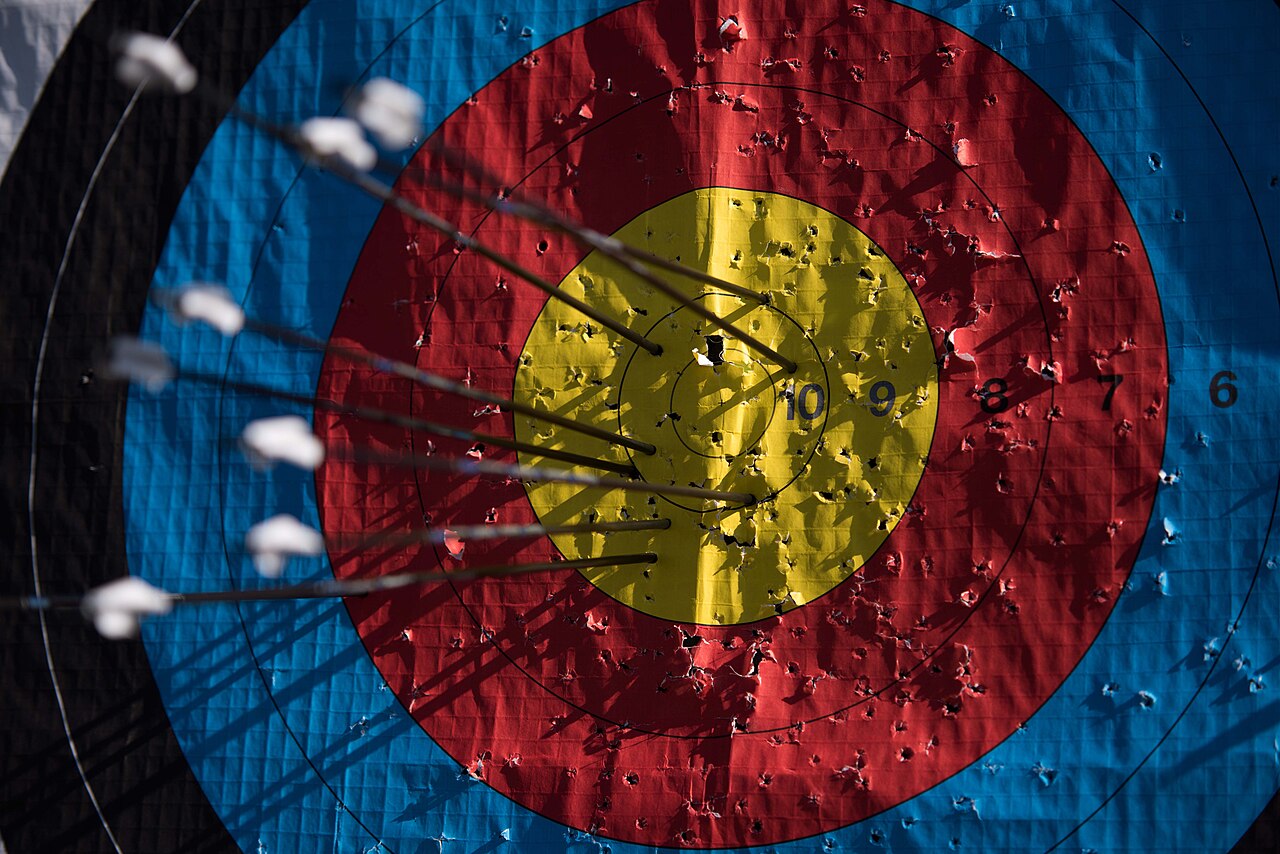
- Events use tri‑spot 40cm target faces (three small spots arranged vertically or triangular) at 18 metres so arrows do not overlap on the same spot. Recurve compound target faces are identical in outer diameter but compound 10‑ring is halved in diameter as standard. Barebow usually shoots a single spot. (worldarchery.sport)
- Recurve targets use a 10‑ring measuring about 4 cm; compound 10‑ring is typically smaller (2 cm). In some trials and finals variations such as a ‘12‑ring’ or a small white bonus dot have been used experimentally; those are event‑specific trial rules and not the baseline IWS qualification format. (worldarchery.sport)
Matchplay: recurve vs compound
Matchplay differs by bow type:
- Recurve matches are decided by the World Archery sets system: best of five sets, each set three arrows; set points determine the winner of the match. This is the standard approach in recurve head‑to‑head matches. (ianseo.net)
- Compound matches use cumulative scoring: a fixed number of ends (for indoor phases usually five ends of three arrows) and the higher total wins. Tie procedures follow World Archery tie‑break rules (single arrow shoot‑offs, closest to centre). (ianseo.net)
Rankings and points — how series standings are built
World Archery publishes two separate lists for the Indoor World Series:
- Open ranking — based on 60‑arrow qualification scores; every participant who competes at registered events receives an open ranking. The open ranking typically uses each archer’s best three qualification scores across the season. (worldarchery.sport)
- Elite ranking — based on final placings after eliminations at events that carry elite points. Historically the elite ranking used each athlete’s best two (or later, best three) results across the season and the top positions would qualify for Finals or prize money. World Archery revised the end‑of‑season mechanics for the 2025–26 season so final elite champions are determined by rankings rather than a single Final. Always check the current season’s official IWS rules for the exact “best N” rule. (ianseo.net)
Points table (example from IWS rules)
World Archery defines positional elite points for the different event grades (1000/500/250). The distribution example used in the IWS rules is shown here (this table is illustrative of the published allocations and used by World Archery in recent seasons):
| Position | World Series 1000 | World Series 500 | World Series 250 |
|---|---|---|---|
| 1st | 1000 | 500 | 250 |
| 2nd | 600 | 300 | 150 |
| 3rd | 500 | 250 | 125 |
| 4th | 300 | 150 | 75 |
| 5th | 250 | 125 | 60 |
| 6th | 200 | 100 | 50 |
| 7th | 190 | 95 | 45 |
| 8th | 180 | 90 | 30 |
| 9th–16th | 90 | 45 | 20 |
| 17th–32nd | 45 | 20 | — |
The series rules and precise point allocations (and whether a particular event awards elite points) are set by World Archery in the event regulations; consult the current season rules for any changes. (ianseo.net)
Special cases: Finals, team formats and experiments
Historically the IWS concluded with a Finals event. Event formats for Finals have sometimes experimented with team‑only formats, short “game” structures and even a 12‑ring or white bonus dot designed to add strategic elements to team matches. These special formats are event‑specific and described in the Finals or event technical documents; they do not replace the standard 60‑arrow + elimination rules used at regular stages. Recent World Archery announcements confirm both experimentation and that some of these rule changes were trialled in dedicated finals or remote events. (worldarchery.sport)
What betting markets appear on Indoor World Series events
Archery is a niche betting market compared with football or tennis; markets are usually only deep around major international competitions (Hyundai Archery World Cup stages, World Archery Championships, Las Vegas Shoot, Olympic matches) and when an official data partner or feed is in place. World Archery’s partnership to provide betting data to industry providers has increased the availability and quality of live markets for major events. (worldarchery.sport)
Typical markets you may see
- Match winner / To win match (head‑to‑head winner). Settled on the match result, including extra arrows if required. (help.bet365.com)
- Set winner / Set handicap (recurve set result markets — available for major matches). (help.bet365.com)
- Total points or totals (e.g., over/under match total) — more common for compound (cumulative) matches. (help.bet365.com)
- Outright winner or tournament winner (season‑long or single event), including “To reach final” markets when eliminations are scheduled. These markets are often suspended or absent outside major stages. (ianseo.net)
- Specials: next set winner, first to X points, or precise score lines — these appear sporadically and mainly at bookmakers covering the World Cup and Olympic events. (livepanthers.com)
Settlement rules commonly reference official score providers or World Archery results pages; many bookmakers explicitly state they will use the official competition provider, and where provider data is unavailable they reserve the right to use independent evidence. Always read a bookmaker’s sport rules for archery settlement details. (help.bet365.com)
Bookmaker coverage and an archery‑bettor evaluation (research selected operators)
Based on bookmaker documentation and market reviews, two operator types are most relevant to archery punters:
- Fixed‑odds mainstream bookmakers (example: bet365) — large operators like bet365 publish sport‑specific rules for archery and are among the bookmakers most likely to put live markets up for major World Archery events and the Olympics. Their strength is market reliability and settlement clarity (they refer to official providers), but market depth is limited compared with mainstream sports. (help.bet365.com)
- Exchange / price‑discovery platforms (example: Betfair Exchange) — exchanges can offer better price discovery and trading if liquidity exists for a match, which is useful for short indoor matches where momentum changes quickly. Liquidity can be thin on smaller events. Exchanges are especially useful as an alternative where fixed‑odds margins are wide. (livepanthers.com)
Editorial assessment (criteria practical guidance)
- Coverage: If your goal is to bet IWS events or World Cup matches, use a large fixed‑odds book with a documented archery rules page (e.g., bet365) as your primary account. These operators are likeliest to list match markets at major stages. (help.bet365.com)
- In‑play features: For live match betting choose a bookmaker with reliable live score updates, partial cash‑out and rapid bet placement. If you trade or want to back/lay positions, pair that primary bookmaker with an exchange account to trade price inefficiencies. This combination is commonly recommended by experienced archery bettors. (livepanthers.com)
- Data integrity: Bookmakers increasingly rely on official feeds and provider partnerships; World Archery’s data partnership makes major events more consistently covered by sportsbooks, and it also improves settlement transparency for bettors. (worldarchery.sport)
- Market depth value: Archery markets are relatively shallow — smart bettors treat many markets as low liquidity and size stakes accordingly. Exchanges can be advantageous when available, but expect variable liquidity. (livepanthers.com)
Separate verified facts (coverage and settlement policies) from editorial opinion (how to use books/exchanges): the former is documented in bookmaker help pages and World Archery announcements, the latter is practical guidance based on market behaviour. (help.bet365.com)
How to approach betting on Indoor World Series events
- Follow official entry lists and World Archery live scores: qualification results and seedings determine matchups and are the best early signal of value. World Archery posts live results and full entries for major stages. (worldarchery.sport)
- Understand format‑dependent edges: recurve set matches can produce upsets because a slow start can be recovered by winning sets; compound cumulative scoring rewards consistency and inner‑10 accuracy. Bet types should reflect that difference (e.g., totals and exact score props are more meaningful in compound). (ianseo.net)
- Manage liquidity and stake sizing: many archery markets are thin — use smaller stakes and prefer matches where bookmakers provide live pricing and a clear score feed. Exchanges can help manage exposure but are subject to liquidity limits. (livepanthers.com)
- Watch for rule variants at Finals or exhibition formats: some finals or team events may use experimental rules (white dot, 12‑ring, games) — markets for those formats are rarer and settlement may differ. Always read event‑specific technical documents. (worldarchery.sport)
Responsible gambling note
This guide is for informational purposes only. Betting involves risk and should only be done by adults in jurisdictions where it is legal. If you choose to bet, stake responsibly and consult local regulations. SaskArchery does not provide betting services — this article evaluates formats and bookmaker practices for archery fans and bettors only.
Frequently asked questions (FAQ)
1. What distance and target face do Indoor World Series archers use
Standard IWS competition is shot at 18 metres on 40cm tri‑spot target faces (three small spots). Recurve and compound use similar outer dimensions but the compound 10‑ring is smaller; barebow typically uses a full single spot. (worldarchery.sport)
2. How are recurve and compound matches different for betting
Recurve uses the set system (best of five sets) where set wins matter; compound uses cumulative scoring over fixed ends. For betting, that means recurve can be more volatile on a short match‑to‑match basis, while compound is often steadier and more suited to totals/aggregate markets. (ianseo.net)
3. Do bookmakers always offer archery markets
No. Archery markets are event‑dependent. Large operators (e.g., bet365, Unibet) and exchanges will typically list markets for major World Archery stages, World Championships, the Olympics and marquee indoor events such as The Vegas Shoot. Coverage for smaller or club‑level IWS registered events is inconsistent. World Archery’s data partnerships have improved feed availability for major events, which helps bookmakers list markets more reliably. (help.bet365.com)
4. What is the difference between the open and elite IWS rankings
The open ranking is based on 60‑arrow qualification scores (best three results typically) and ranks all participating archers. The elite ranking awards positional points for final placings in select stages (1000/500/250 systems) and has been used to determine season champions or Finals qualifiers (rules on the number of “best results” and Finals format have changed over seasons — check the current season document). (worldarchery.sport)
5. Where can I find the official event rules and live scores
World Archery publishes event rules, ranking pages and live scores on its website. Major stages also provide full entry lists and schedules. Event organisers such as The Vegas Shoot also publish stage schedules and format details. Use the World Archery event pages and the official event websites for the most authoritative information. (worldarchery.sport)