Field Archery Format Explained
Field Archery Format Explained
Field archery is the off‑target cousin of Olympic‑style target archery: instead of a flat, level range with uniform distances, athletes walk a course through natural terrain and shoot at a mix of marked and unmarked targets laid out on uneven ground. This guide explains the formats you will see at national and international competitions (World Archery and IFAA/NFAA styles), how courses and scoring work, how multi‑day championships are structured, and what archery bettors should expect from bookmakers when markets appear.
Quick overview — what makes field archery different
- Courses are shot over natural terrain (woodland, hills, rough ground) and include uphill and downhill shots, varying sight lines and obstacles.
- Rounds use a fixed number of targets (commonly 24 or 28 depending on the ruleset) with multiple arrows per target (usually three for paper “field” rounds, two for 3D). Distance markers may be shown (marked) or hidden (unmarked).
- There are two main international rule families in common use: World Archery’s Field 3D rules (used at World Archery events and many national federations) and the IFAA/NFAA family (common in traditional/3D competition and some national championships). Each defines specific rounds (Field, Hunter, Animal, 3D) and championship schedules. (extranet.worldarchery.sport)
Core rounds and formats (World Archery vs IFAA/NFAA)
World Archery (WA) field rounds — the WA 24 family
World Archery’s field rules define a group of 24‑target rounds that are widely used at international events. Key features:
- WA 24 Unmarked — 24 targets with distances not shown to archers (unmarked course).
- WA 24 Marked — 24 targets at known (marked) distances.
- WA 24 Mixed — a single 24‑target day combining marked and unmarked targets (often 12 + 12).
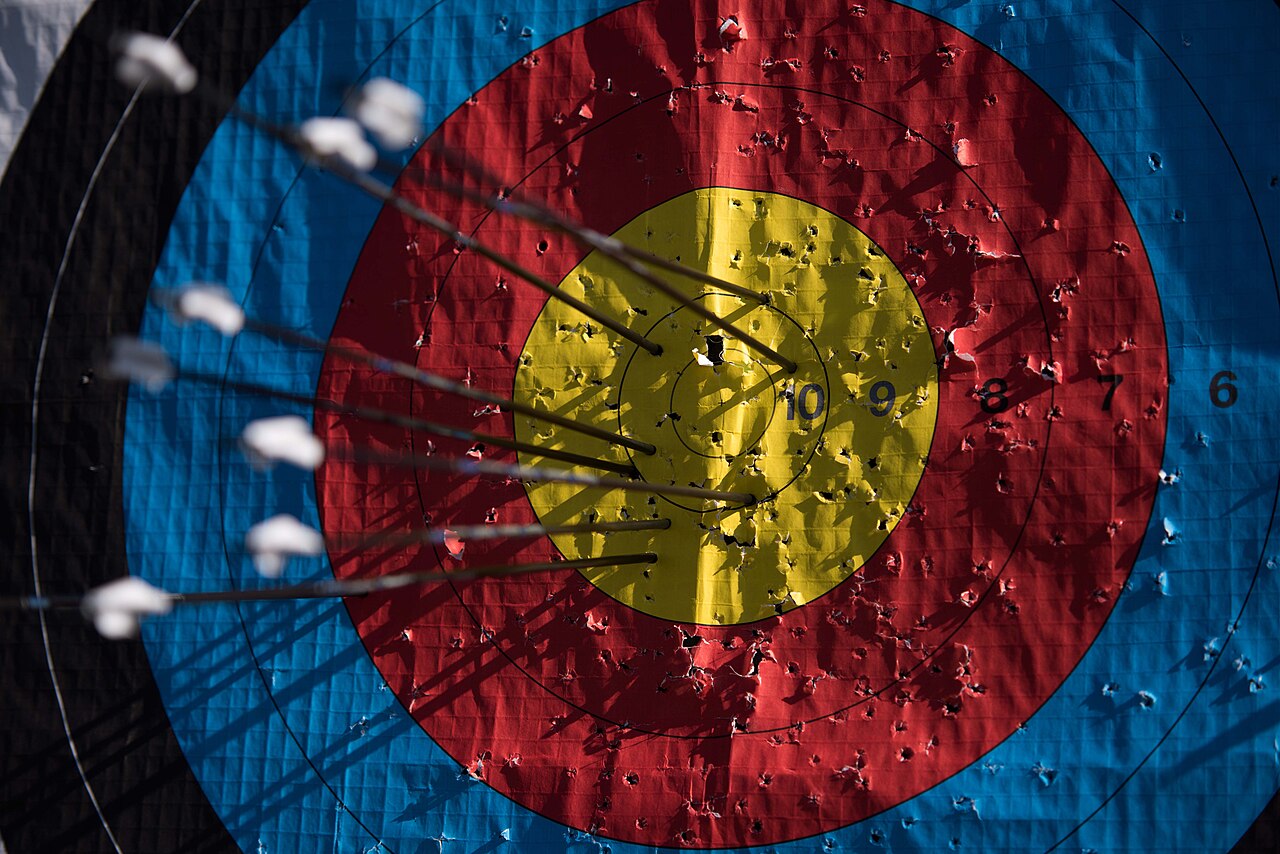
- WA Combined Field round — typically two WA 24 rounds shot on consecutive days (for example Unmarked one day, Marked the next), used to decide many championship titles and records. Each target is shot with three arrows. For field faces the inner yellow scores 6 points (outer yellow 5, black rings 4–1). A single day’s perfect score is 432 (24 targets × 3 arrows × 6 points), combined two‑day maximum 864. (extranet.worldarchery.sport)
World Archery specifies target face sizes (80cm, 60cm, 40cm, 20cm), peg colours that indicate which divisions shoot from which peg (red typically furthest, blue nearer, yellow/white nearest), and course‑laying requirements to preserve the discipline’s emphasis on terrain and variability. Groups of 2–4 archers usually follow the course together and shoot three arrows per target. (extranet.worldarchery.sport)
IFAA / NFAA style rounds — Field, Hunter, Animal and 3D
The IFAA (International Field Archery Association) and NFAA (National Field Archery Association, U.S.) family define a slightly different set of standard rounds that recreational and bowhunter‑style competitions commonly use:
- Field Round (IFAA/NFAA) — typically units of 14 or 28 targets, with even (regular) distances and conventional concentric face scoring (5–1 or 5–3 depending on class).
- Hunter Round — uses uneven distances and an all‑black face with white bullseye; distances are often shorter and scoring zones arranged to mimic hunting shot difficulty.
- Animal Round and 3D Rounds — life‑sized animal silhouettes or painted paper animal faces (scoring often distinguishes “vital” and “non‑vital” zones; walk‑up/fan station formats are common where the archer advances if they miss). 3D events are most often shot at unmarked distances to simulate hunting scenarios. (nfaausa.com)
IFAA world championships follow a multi‑day program that mixes Field, Hunter and Animal rounds; at the IFAA World Field Archery Championship (WFAC) the standard format runs over several days with marked distance rounds used for official world scoring. The IFAA Book of Rules describes a WFAC layout that typically includes Field, Hunter and Animal rounds across the week. (scribd.com)
Course layout, targets and scoring — the mechanics
Targets, faces and points
- World Archery field faces use five main scoring zones with the inner yellow counting as the highest value (6), outer yellow 5, then black rings 4–1 (for field faces). Target face size and distance ranges are specified for each division. (extranet.worldarchery.sport)
- IFAA/NFAA round faces and animal targets use different scoring tables (e.g., Field 5–3 scoring on some faces, animal rounds awarding different points for the first arrow that scores in a vital zone). Read the specific event rulebook for the round you’re attending. (en.wikipedia.org)
Marked vs unmarked distances
On marked courses the peg or indicator displays the shooting distance to that target; archers choose the peg corresponding to their division. Unmarked courses hide distances and require archers to judge the range; these are valued for testing field range‑estimation and wind compensation. Many championship formats deliberately mix marked and unmarked rounds (for instance a WA Combined round uses an Unmarked day and a Marked day). (extranet.worldarchery.sport)
Shooting order, groups and arrows per target
- Most field rounds have groups of 2–4 archers that walk the course together. In World Archery field rounds each archer shoots three arrows per target. 3D rounds more commonly use two arrows per target. (extranet.worldarchery.sport)
- For major World Archery events, time control equipment and visual indicators may be used to keep matches on schedule; match‑play targets (elimination matches) adopt alternating shooting signals analogous to target archery. Event rulebooks specify the exact timing allowances (and World Archery includes timing articles in their rule books). (scribd.com)
Championship structure and typical schedules
World Archery / international championship model
At World Archery‑sanctioned field events the competition commonly uses a qualification phase made up of WA 24 rounds (often one Unmarked and one Marked round shot over consecutive days), and in some events a combined total determines seeding for elimination rounds. The WA rule books and event regulations define elimination and finals formats where head‑to‑head matchplay is used for medals in some divisions and team events. For the most authoritative and current competition structures, consult the World Archery event documents and Book 4. (extranet.worldarchery.sport)
IFAA World Field Archery Championship (WFAC) example
The IFAA WFAC is a multi‑day championship that explicitly schedules Field, Hunter and Animal rounds over several days (the WFAC program described in IFAA rules stretches across 5–7 days, mixing marked distance rounds and animal/3D formats). Championship scoring and tie‑break procedures for awards (for example shoot‑offs) are spelled out in the IFAA handbook. If you plan to follow or bet on a WFAC event, check the published event program before placing markets tied to specific rounds or days. (scribd.com)
How field archery betting markets look (and when they appear)
Archery betting is a niche market compared with mainstream sports. Market availability is strongly event‑dependent: bookmakers typically open archery markets for the Summer Olympic Games, World Archery Championships, the Hyundai Archery World Cup series and some continental championships. Outside those major events, many sportsbooks will not list archery markets or will restrict offerings to a few outright/podium markets. Review sites and sportsbook APIs show that large international bookmakers (for example, well‑known books in major regulated markets) include “Archery” as a contest type in their systems and tend to surface markets only around big events. (bettingranker.co.uk)
Common archery markets you may see
- Outright winner / event winner (individual and team).
- Match winner (head‑to‑head elimination matches) — often offered live during elimination matches.
- Set or end markets (next set winner, total set points) during live matches.
- Props (e.g., “most 10s”, margin of victory) at major events — rarer and highly bookmaker‑dependent.
In‑play: what to expect
When bookmakers run in‑play archery markets they commonly present match winner, next set winner, and small‑prop markets; liquidity is shallow compared with football or tennis, and prices can move quickly between ends. For that reason, bettors should check whether the bookmaker provides a live score/tracker and whether cash‑out is available on archery markets before staking significant amounts. Coverage and live market depth differ a lot between operators and jurisdictions. (livepanthers.com)
Picking a bookmaker for field‑archery betting — an archery bettor’s checklist
If you want to place stakes on field archery (or 3D/animal rounds that sometimes appear on the same schedule), consider these criteria:
- Event coverage: confirm the operator lists the specific event (Olympics, World Championships, World Cup stage, WFAC) you want to bet on. Market presence is not continuous — it’s usually centred on major competitions. (bettingranker.co.uk)
- Market depth odds refresh: for live match betting you need fast odds updates and small latency; some large books are better equipped for fast in‑play archery markets. (livepanthers.com)
- Settlement rules official sources: check the sportsbook’s rules for how archery bets are settled (official result source, treatment of shoot‑offs, in‑progress voiding). Reputable books list archery in their sports rules section and confirm settlement on official governing‑body results. (vbet.com)
- Data/tracker availability: a live score or shot‑by‑shot tracker is extremely useful for reacting to tight elimination matches; many books lack a stream for archery, so a reliable scoreboard is valuable.
- Regulatory/licence status and consumer protections: always prefer licensed operators in your jurisdiction and check the book’s rules on voided markets and appeal/penalty handling.
Example providers mentioned in betting‑coverage reviews and API listings include large international books that historically include archery on their sports menus (but remember: their archery coverage is event‑driven and varies over time). Always verify market availability on the bookmaker’s site for the specific event you plan to follow. (livepanthers.com)
Practical tips for bettors who follow field archery
- Know the round: a WA 24 Unmarked day is a different test (range judgement, variable target faces) than a Marked Hunter or Animal round — look for archers who perform strongly across both formats if